News / Research note · 27 November 2026
An earthquake outlook
for Andalucía.
We took our event-oriented model architecture to earthquake data. It was a natural place to ask a larger question: what can a model learn when time and interacting processes are part of how it computes?
Earthquakes arrive at irregular times, across different locations. Activity clusters, quiet periods matter, and one event changes the context for what may come next. These are the kinds of patterns our architecture was built to represent.
We wanted to learn those patterns from earthquake histories and use them to forecast how activity might unfold. The early results encouraged us: in internal evaluations, our earthquake models produce more accurate probabilistic forecasts than the leading published models we tested. We’ll share the detailed research as it is released.
From the research to Andalucía
Recent earthquakes around Granada gave the work a more immediate purpose. With public interest in the area’s outlook, we prepared a regional forecast for part of Andalucía.
The model is general: with suitable earthquake catalogue data, it can be applied to any area. Andalucía is one application of that broader work.
The forecast below brings many possible future earthquake sequences together into a view of expected activity over the coming year.
This issue of the outlook starts its one-year window on 27 November. The model learns from each newly observed earthquake before the forecast is issued.
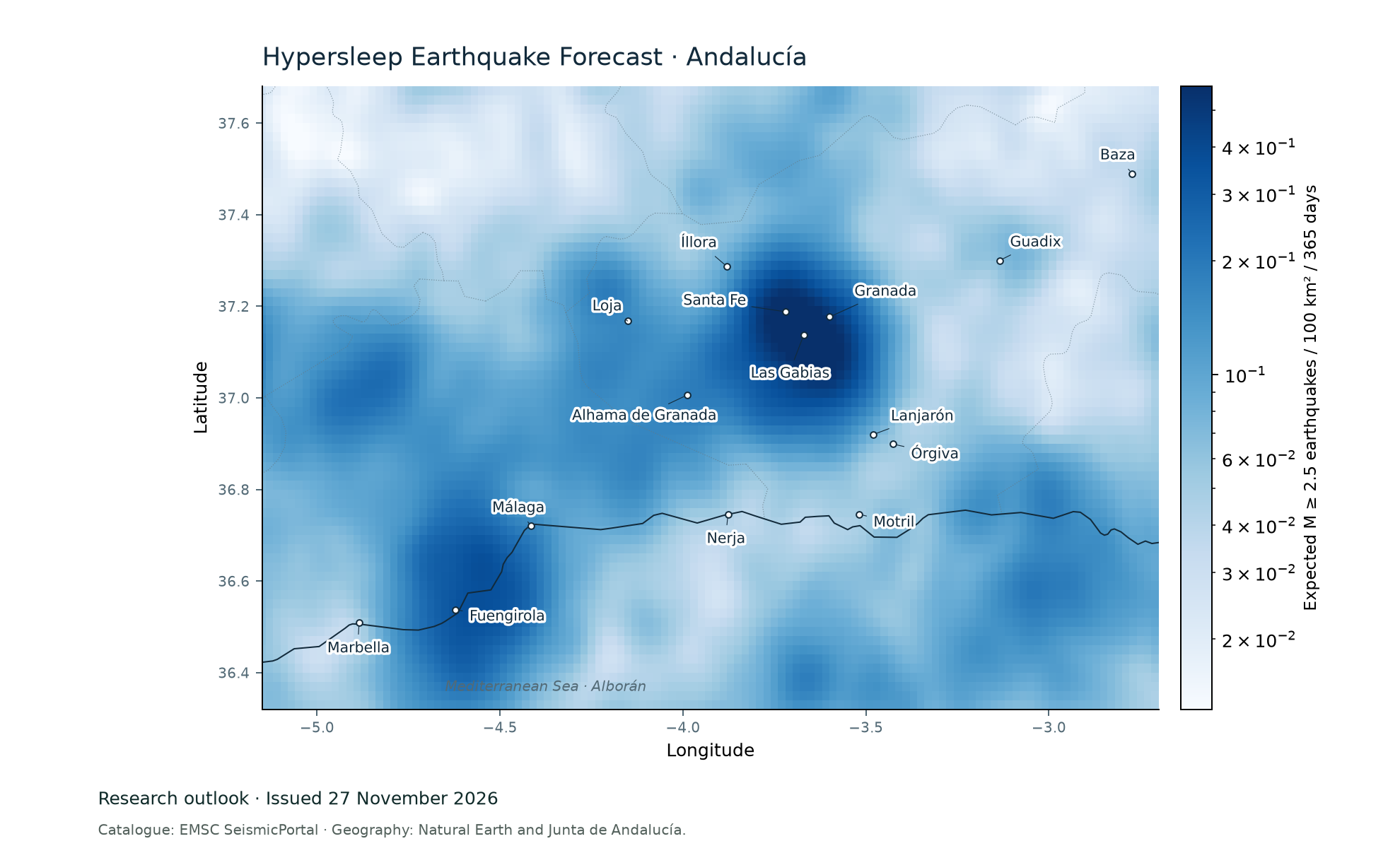
Expected earthquakes of magnitude 2.5 and above over 365 days, per 100 square kilometres. Darker areas indicate higher modelled activity. Research issue dated 27 November 2026.
Reading the map
The shading shows expected earthquake activity averaged across possible future sequences. It describes where events are more likely over that period, with uncertainty about where and when individual earthquakes will occur.
Earthquake occurrence is separate from shaking, damage and emergency warning. Those questions require additional information and models.
This issue’s numbers
Probability of at least one earthquake of magnitude 4 or above within 25 km of the town centre over the next 365 days, from 512 complete future scenarios:
| Place | M ≥ 4, next 365 days | 95% interval |
|---|---|---|
| Granada | 10.7% | 8.3%–13.7% |
| Las Gabias | 11.3% | 8.9%–14.4% |
| Málaga | 9.0% | 6.8%–11.8% |
| Marbella | 5.1% | 3.5%–7.3% |
Across the whole model region the scenarios expect 86.3 earthquakes of magnitude 2.5 or above over the same year. Intervals describe simulation uncertainty only; catalogue and model uncertainty are separate.
How it compares
Forecast quality is measured as total log-likelihood per event (higher is better), scored on each catalogue’s official test set of the public EarthquakeNPP benchmark. The full record is on the Results page.
| Model | ComCat M≥2.5 | Salton Sea M≥1.0 | San Jacinto M≥1.0 | SCEDC M≥2.0 | SCEDC M≥2.5 | SCEDC M≥3.0 | White Island M≥0.6 | Mean |
|---|---|---|---|---|---|---|---|---|
| ETAS (benchmark reference) | -7.255 | 0.017 | -4.266 | -4.993 | -5.399 | -5.780 | -2.240 | -4.274 |
| Hypersleep (ours) | -7.195 | 0.073 | -4.175 | -4.937 | -5.337 | -5.696 | -2.220 | -4.212 |
Hypersleep leads on all seven catalogue configurations, by +0.020 to +0.091 nats/event in total (mean +0.061). Spatial log-likelihood per event is also ahead on all seven (+0.031 to +0.099), and temporal scores are within 0.01 nats/event of ETAS on six of the seven. One validation-selected fit per catalogue; public data and scorer.
Data and issue date
This issue uses the EMSC earthquake catalogue available through 27 November 2026 at 10:26 UTC (2,926 events; latest reported origin 22 November 2026). Catalogue completeness, later revisions and model uncertainty affect the outlook.
Catalogue: EMSC SeismicPortal, CC BY 4.0. Geography: Natural Earth and Junta de Andalucía SIMA.